KC-1667

293T-NFκB-Luc2-mouse-CD40 Cell Line

×
22577
Home » Cell Lines » 293T-NFκB-Luc2-mouse-CD40 Cell Line

Background of 293T-NFκB-Luc2-mouse-CD40 Cell Line

CD40 encodes a tumor necrosis factor receptor superfamily member that functions as a cell-surface receptor on antigen-presenting cells and mediates immune and inflammatory responses. The receptor is central to T cell-dependent immunoglobulin class switching, memory B cell development, and germinal center formation. It is also reported to participate in broader immune system processes and cell surface receptor signaling.

Specifications

Catalog NumberKC-1667
Cell Line Name293T-NFκB-Luc2-mouse-CD40 Cell Line
Host Cell Line293T-NFκB-Luc2 Cell Line
DescriptionStable 293T cell line expressing exogenous luciferase under the control of NFκB responsive element and overexpressing mouse CD40 sequence.
QuantityOne vial of frozen cells (≥2×10⁶ cells)
StabilityStable in culture over a minimum of 10 passages
ApplicationDrug screening and biological assays
Freezing Medium70% DMEM + 20% FBS + 10% DMSO
Propagation MediumDMEM + 10% FBS + 150μg/mL Hygromycin B+1μg/mL Puromycin
Selection MarkerHygromycin B and Puromycin
MorphologyEpithelial
SubcultureSplit saturated culture 1:4-1:6 every 2-3 days; seed out at about 1 × 10⁵ cells/mL
Incubation37 °C with 5% CO2
StorageLiquid nitrogen immediately upon receiving
Doubling TimeApproximately 30 hours
Mycoplasma StatusNegative
In Vivo ValidationNA

Cell Line Generation

293T-NFκB-Luc2-mouse-CD40 Cell Line was generated using a lentiviral vector expressing exogenous luciferase under the control of NFκB responsive element and overexpressing mouse CD40 sequence.

Characterization

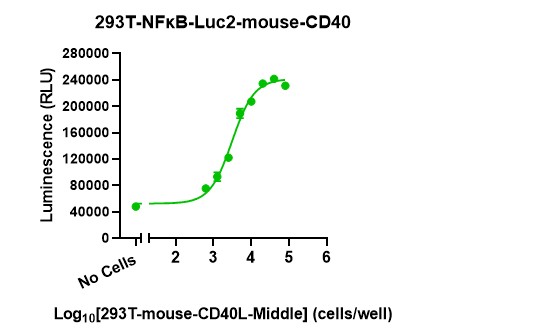
Figure 1: 293T-NFκB-Luc2-mouse-CD40 cell were seeded into 96-well plates, 293T-mouse-CD40L-Middle were added to 96-well plate for 16 hrs, and then read out using Bright-Glo Detection System.

Cell Resuscitation

"
  1. Prewarm culture medium (DMEM supplemented with 10% FBS, 150μg/mL Hygromycin B and 1μg/mL Puromycin ) in a 37°C water bath.
  2. Thaw the frozen vial in a 37°C water bath for 1-2 minutes.
  3. Transfer the vial into biosafety cabinet, and wipe the surface with 70% ethanol.
  4. Unscrew the top of the vial and transfer the cell suspension gently into a sterile centrifuge tube containing 9.0mL complete culture medium.
  5. Spin at ~ 125 × g for 5-7 minutes at room temperature, and discard the supernatant without disturbing the pellet.
  6. Resuspend cell pellet with the appropriate volume of complete medium and transfer the cell suspension into a T25 culture flask.
  7. Incubate the flask at 37°C, 5% CO2 incubator.
  8. Split saturated culture 1:4-1:6 every 2-3 days; seed out at about 1 × 10⁵ cells/mL.
"

Cell Freezing

"
  1. Prepare the freezing medium (70%DMEM + 20% FBS + 10% DMSO) fresh immediately before use.
  2. Keep the freezing medium on ice and label cryovials.
  3. Transfer cells to a sterile, conical centrifuge tube, and count the cells.
  4. Centrifuge the cells at 250×g for 5 minutes at room temperature and carefully aspirate off the medium.
  5. Resuspend the cells at a density of at least 3×10⁶ cells/mL in chilled freezing medium.
  6. Aliquot 1 mL of the cell suspension into each cryovial.
  7. Freeze cells in the CoolCell freezing container overnight in a -80°C freezer.
  8. Transfer vials to liquid nitrogen for long-term storage.
"

References

"
  1. Vial G, Gensous N, Duffau P. L’axe CD40-CD40L : implications actuelles et futures en immunologie clinique [The CD40-CD40L axis: Current and future implications in clinical immunology]. Rev Med Interne. 2021 Oct;42(10):722-728. French. doi: 10.1016/j.revmed.2021.02.005. Epub 2021 Mar 2. PMID: 33674076.
  2. Seijkens T, Kusters P, Engel D, Lutgens E. CD40-CD40L: linking pancreatic, adipose tissue and vascular inflammation in type 2 diabetes and its complications. Diab Vasc Dis Res. 2013 Mar;10(2):115-22. doi: 10.1177/1479164112455817. Epub 2012 Sep 10. PMID: 22965071.
"

Use License Agreement

Research Use Only.
Not for use in diagnostic procedures or therapeutic applications.
Redistribution of the cell line or its derivatives is prohibited without prior written permission from Kyinno Biotechnology.