Understand how deep learning and geometric models are overcoming the structural data gap, why CDR loop geometry is central to prediction accuracy, and how to build a validated antibody pipeline from sequence input to candidate selection.
Why Antibody Structure Prediction Matters
Antibodies are the workhorse molecules of the adaptive immune system and of modern biopharmaceutical development. Their Y-shaped architecture allows them to bind with extraordinary specificity to foreign antigens, a property that has been used to produce many approved therapeutic products targeting cancer, autoimmune diseases, infectious disease, and more.
This therapeutic context makes machine learning and artificial intelligence relevant to antibody research, especially when monoclonal antibodies must be evaluated across binding and developability criteria.
Despite this clinical success, the development of new therapeutic antibodies remains slow, expensive, and failure-prone. A central bottleneck is structural characterization: knowing exactly how an antibody folds and how its binding site geometrically complements a target antigen. Conventional structure determination methods, including X-ray crystallography, cryo-electron microscopy (cryo-EM), and nuclear magnetic resonance (NMR) spectroscopy, are resource-intensive and difficult to apply at the scale of sequence diversity generated by next-generation sequencing.
At the molecular level, protein structure, protein folding, amino acid composition, and molecular surfaces shape the antigen–antibody complex and its binding behavior.
Artificial intelligence (AI) and deep learning are changing this equation. By learning structural and evolutionary patterns from experimental structures and large antibody sequence collections, AI models can predict three-dimensional antibody conformations from amino acid sequence and support higher-throughput analysis. Antibody-specific language models have also demonstrated end-to-end structure prediction from individual sequences [2]. These deep learning methods use neural information processing systems and structure prediction networks to learn relationships among protein sequences, protein structures, and antibody sequences. Readers new to this field may want to review foundational concepts in antibody discovery before exploring AI-based structure prediction approaches. This guide explains how these methods work and what they mean for computational biologists and ML scientists in drug discovery.
For practical antibody design, each computational model should be matched to the intended antibody structure prediction task and validated with relevant data.
Antibody Architecture and the Structural Prediction Problem
To understand what AI is predicting, you first need a precise mental model of antibody structure and the specific challenges that make it hard.
Heavy & Light Chains
IgG antibodies consist of two heavy chains (HC) and two light chains (LC), encoded through immunoglobulin gene recombination. The variable domains (VH and VL) carry the antigen-binding surface.
CDR Loops (1-3, H&L)
Six complementarity-determining region (CDR) loops, three on each chain, form the paratope. CDR-H3 is the most variable in length, sequence, and structure, making it especially important for antigen recognition and the hardest loop to model accurately [1].
The complementarity-determining regions include hypervariable regions whose amino acid patterns define CDR loop structures and influence antigen–antibody complex formation.
Framework Regions
The four framework regions (FR1-FR4) flanking each CDR provide structural scaffolding. Their comparatively conserved architecture makes them more amenable to template-based and learned structural modeling than the hypervariable loops.
Paratope-Epitope Interface
The three-dimensional fit between the antibody paratope and antigen epitope determines binding affinity and specificity. Shape complementarity, electrostatics, hydrogen bonding, and buried surface area are important interface features.
Accurate antibody design therefore requires models that connect interface properties to the geometry of the antigen–antibody complex structure.
The Data Gap Problem
Only several thousand experimentally determined antibody structures are available, while antibody sequence diversity is vastly larger. This imbalance limits training coverage, particularly for uncommon CDR-H3 conformations and flexible antigen-binding states [1].
Because uncommon hypervariable regions are underrepresented, structure prediction networks may extrapolate poorly when antibody structures differ from their training data.
Immunoglobulin Classes
IgG dominates therapeutic antibody development. IgM, IgA, IgE, and IgD each have distinct structural features. Prediction models must also generalize across engineered formats, including scFv, Fab, bispecific, and single-domain antibodies.
Models trained primarily on monoclonal antibodies may require separate evaluation for VHH antibodies and other engineered formats.
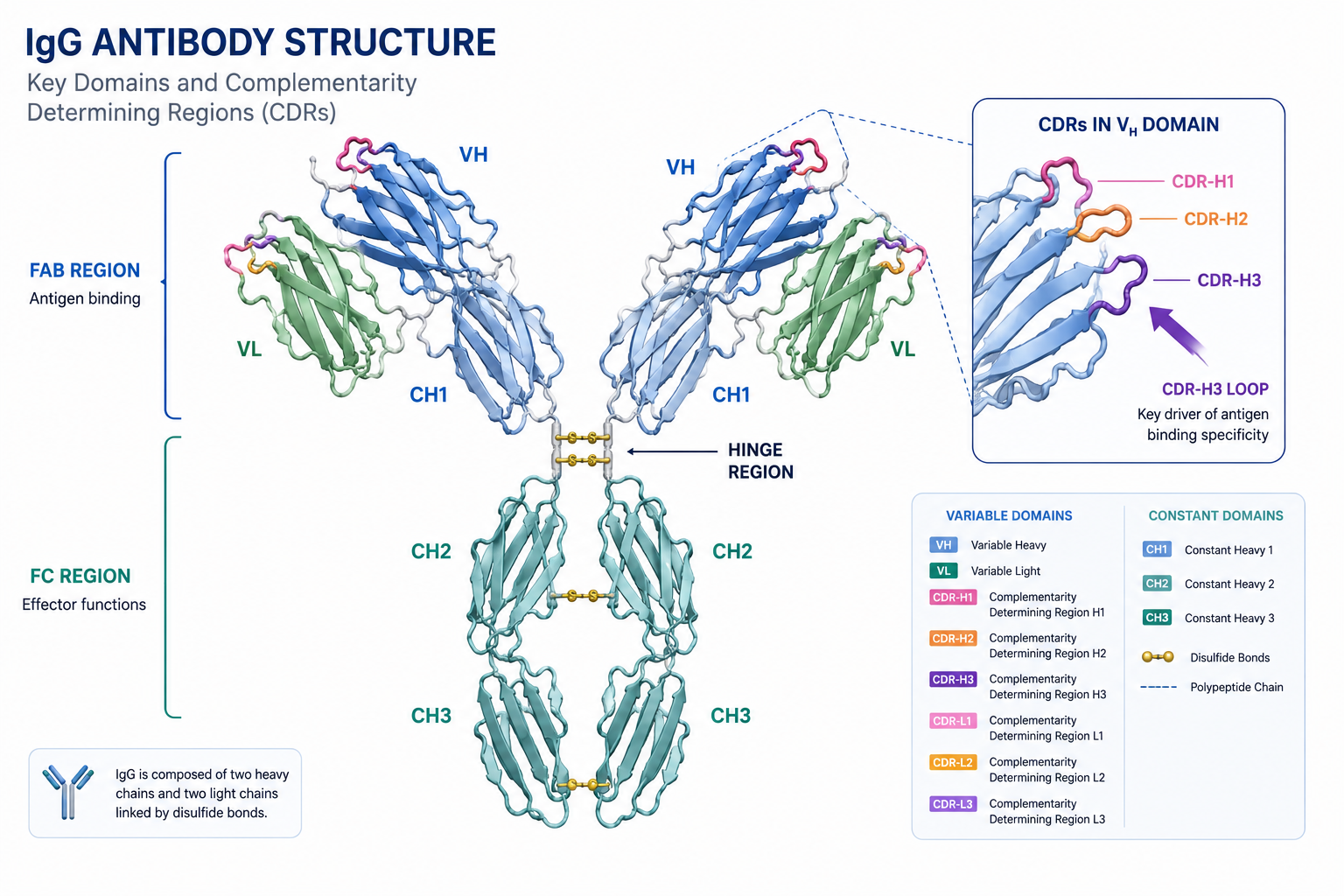
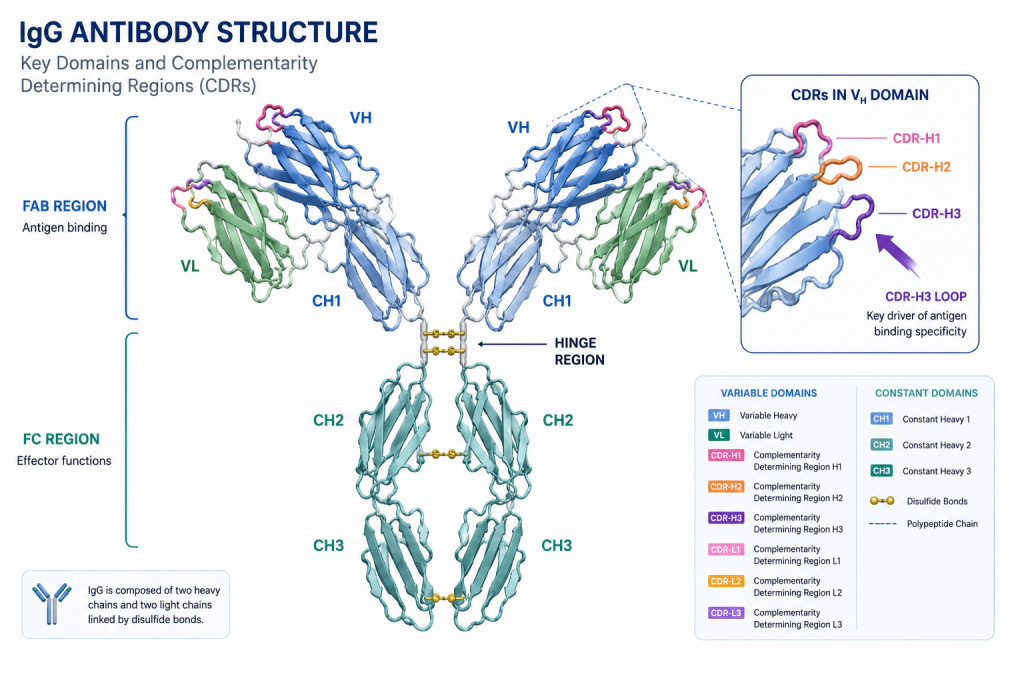
Figure 1. Structure of an IgG antibody highlighting the Fab and Fc regions, VH/VL and CH1–CH3 domains, hinge region, disulfide bonds, and complementarity-determining regions (CDR-H1/H2/H3 and CDR-L1/L2/L3). The CDR-H3 loop is emphasized because it plays a central role in antigen recognition and binding specificity.
For antibody design, amino acid substitutions in hypervariable loops should be interpreted against the complete antibody structure.
Deep Learning vs. Traditional Methods
For decades, antibody structure prediction relied on homology modeling, which identifies a structurally similar template and uses it to model the query sequence. This remains useful for conserved framework regions but is less reliable for CDR-H3 loops without close structural analogs. These AI models are increasingly combined with established antibody discovery technologies and screening platforms to accelerate lead identification.
Sequence-based methods and computational methods can complement template search, but protein structure prediction remains sensitive to the available structural context.
| Capability | Homology Modeling | AI / Deep Learning |
| CDR-H3 loop accuracy | Limited for diverse or template-poor loops | Improved by antibody-specific training, but still the hardest region |
| Throughput | Best suited to smaller or prioritized sequence sets | Can support large-scale sequence and structure analysis |
| Requires structural template | Usually | Not always; some methods are sequence-only |
| Binding interface prediction | Often requires a separate docking step | Can be integrated with co-folding or AI-guided docking |
| Novel CDR sequences | Constrained by available templates | Can generalize beyond close templates, with uncertainty |
| Multi-property optimization | Difficult to scale | Can combine affinity, stability, solubility, and developability scores |
A robust antibody design framework should compare multiple AI architectures rather than assume one network will generalize across all antibody structures.
The Three AI Paradigms in Antibody Modelling
Protein Language Models (PLMs)
Transformers trained on large protein or antibody sequence corpora learn statistical patterns that function as a form of structural grammar. BALM, for example, was trained on 336 million nonredundant antibody sequences and was used as the foundation for BALMFold, an end-to-end antibody structure predictor [2]. These models can perform well on framework regions and sequence-based property tasks but still require careful evaluation for hypervariable CDR-H3 conformations.
A transformer-based PLM can support sequence-based antibody design by encoding amino acid context across protein sequences and hypervariable regions.
Large language models and neural information processing systems can also support antibody sequence design, although their outputs require structural and experimental checks.
Geometric Deep Learning (GDL)
Graph neural networks and SE(3)-equivariant models operate directly on three-dimensional molecular representations while respecting rotational and translational symmetries. Antibody-specific models have improved overall structure and CDR-loop prediction, although independent evaluation continues to show greater variability in CDR-H3 than in the framework [1].
These structure prediction networks learn geometric features from protein structures and can help compare alternative antibody structures within an antigen–antibody complex.
Generative Diffusion Models
Diffusion-based methods learn to generate antibody backbones and sequences conditioned on target or epitope geometry, enabling de novo design rather than prediction alone. Recent studies have demonstrated de novo generation of antibody CDRH3 with a pre-trained model [5] and experimentally validated epitope-specific antibodies designed with RFdiffusion [6].
Generative artificial intelligence enables deep generative design, protein structure generation, and de novo antibody designs conditioned on target geometry.
In this setting, a protein backbone may be generated first, followed by antibody sequence design and in silico filtering.
Antigen-conditioned antibody design can then focus sampling around a specified antigen–antibody complex structure.
Hybrid AI + Physics Models
Combining neural-network predictions with molecular docking, energy functions, or molecular dynamics refinement can pair the pattern-recognition capabilities of deep learning with physical plausibility checks. AI-augmented physics-based docking for antibody-antigen interactions has shown that ensemble quality, model prioritization, and CDR-H3 length materially affect docking performance [4].
Hybrid computational methods can combine molecular docking with protein-protein interactions, protein-ligand binding scores, and protein structure design.
These lab-in-the-loop approaches use Deep Learning for rapid ranking while physics-based refinement tests the plausibility of the antigen–antibody complex.
AI Architecture Overview Diagram
Side-by-side architecture panels: PLM (transformer encoder blocks), GDL (graph nodes = residues, edges = contacts), diffusion (forward noise / reverse denoise), hybrid (neural prediction + physics refinement pipeline).
Suggested visual: four-panel architecture diagram
Fig. 3 – Architectural overview of the four AI paradigms applied to antibody structure prediction and design.
A comparative antibody design evaluation should test structure prediction networks across representative protein structures.
Practical Workflow: From Sequence Input to Validated Antibody Model
A production-grade AI antibody pipeline can be organized into seven discrete stages. Each stage has specific data requirements, tooling choices, and quality checkpoints.
1. Data Preparation: Sequence Input and Preprocessing
Ingest antibody sequences in FASTA, AIRR-seq, or NGS-derived formats. Annotate VH/VL framework and CDR regions using IMGT numbering with tools such as ANARCI or Abnumber. Flag non-canonical residues. For repertoire-scale work, filter for productive rearrangements and verify chain pairing where available.
For large datasets, antibody repertoire analysis can combine OAS database records, single-cell RNA sequencing, single B Cell Screening, and Hybridoma Sequencing outputs.
Standardized antibody sequence design begins with reliable annotation of protein sequences and chain-pair metadata.
2. Structure Prediction: AI-Driven 3D Structure Modeling
Run sequences through an antibody-specific model such as IgFold or ABodyBuilder2, or use a general complex predictor when paired chains and antigen context are required. Prioritize models trained or benchmarked on antibody-specific data, particularly when CDR-H3 geometry is central to the downstream decision.
Antibody structure prediction in production may compare several structure prediction networks and select models according to format-specific validation.
The selected antibody design process should retain alternative antibody structures when CDR uncertainty is high.
3. Quality Assessment: Model Confidence Scoring
Evaluate per-residue and interface confidence using the metrics provided by the selected model. Inspect CDR regions separately rather than relying on a global confidence score. Reject structures with clashes, nonphysical stereochemistry, implausible bond geometry, or inconsistent CDR conformations. A published assessment of 137 antibody models found tool-dependent artifacts, including D-amino acids, cis-amide bonds, and severe clashes, reinforcing the need for post-prediction structural validation [1].
Quality checks should evaluate protein backbone geometry, complementarity-determining regions, and CDR-related developability properties rather than relying only on global scores.
These checks help prevent antibody design decisions from being driven by physically implausible protein structures.
4. Interaction Modeling: Antigen Docking and Interface Analysis
Perform antibody-antigen docking with tools such as ClusPro or HADDOCK, or use AI-guided co-folding and docking approaches. Compute buried surface area, hydrogen-bond networks, shape complementarity, and predicted binding-energy features. Enhanced antibody-antigen structure prediction has been demonstrated by combining docking-generated models with AlphaFold2 rescoring [3], while newer AI-augmented physics-based workflows emphasize ensemble selection and application-specific quality criteria [4].
For each antigen–antibody complex structure, interface geometry and residue contacts should be reviewed across multiple conformational hypotheses.
Neural information processing systems can rank candidate poses, but an antigen–antibody complex still requires physics-aware and experimental evaluation.
Antibody sequence design should not proceed from a single docking pose when the antigen–antibody complex structure is uncertain.
5. Affinity Optimization: In Silico Mutagenesis and Optimization
Use AI-guided mutagenesis or inverse-folding methods to explore CDR variants that may improve predicted binding while preserving stability, solubility, and manufacturability. Treat predicted affinity as a ranking signal rather than an experimentally measured KD unless the method has been calibrated for the target and assay context.
Machine learning can support antibody sequence design by ranking mutations against structural, stability, and expression-related criteria.
For antibody humanization, sequence-based antibody design should preserve framework compatibility and key contact residues.
6. Candidate Ranking: High-Throughput Screening and Clustering
Score large candidate pools with computationally efficient surrogate models. Cluster candidates by predicted structural similarity or sequence embeddings to preserve diversity across the selected set. Accurate structural models can also inform assay design and hit-triage strategies for high-throughput screening in drug discovery. Shortlist a structurally diverse candidate set for wet-lab synthesis rather than selecting only the highest predicted score.
High-throughput antibody design may use machine learning surrogates for rapid in silico screening of protein binder candidates before wet-lab testing.
Candidate diversity should cover multiple antibody structures, protein backbone geometries, and hypervariable regions.
Antibody sequence design can then prioritize representatives from each cluster rather than a single top-scoring family.
7. Experimental Validation: Wet-Lab Validation and AI Feedback Loop
Synthesize prioritized candidates, measure KD by surface plasmon resonance (SPR) or biolayer interferometry (BLI), and characterize thermal stability and other developability properties. Feed experimental results back into the ranking or surrogate model as active-learning labels. This closed-loop approach helps the model learn from target-specific failures and successes.
Recombinant protein expression provides a direct test of whether antibody design outputs can be produced at useful yield and quality.
High-throughput automation and lab-in-the-loop approaches can return assay results to machine learning models with less manual delay.
This feedback supports Antibody Research by connecting computational methods with experimentally measured outcomes.
End-to-End Pipeline Flow Diagram
Horizontal swimlane diagram showing sequence -> structure prediction -> docking -> optimization -> ranking -> synthesis -> SPR validation -> feedback loop arrow back to optimization.
Suggested visual: swimlane flow diagram with feedback arrow
Fig. 4 – Seven-stage AI-to-wet-lab closed-loop pipeline for antibody candidate optimization.
Each antibody design cycle should preserve amino acid provenance and retain alternative antibody structures for review.
Evaluating Predictive Accuracy: Metrics and Benchmarks
Choosing the right accuracy metric depends on what you are optimizing for. Structural accuracy, interface confidence, binding-affinity ranking, and enrichment each measure a different capability. Study-specific figures should not be presented as universal model performance.
Benchmarking antibody structure prediction should report local errors in the complementarity-determining regions and the antigen–antibody complex structure.
Deep Learning benchmarks should also separate protein structure quality from downstream candidate-ranking performance.
Study-Specific Benchmark Snapshots
| Metric | Reported result | Scope and interpretation |
| BALM training corpus | 336 million sequences | Nonredundant unlabeled antibody sequences used to train one antibody-specific language model [2] |
| Cryo-EM-validated VHH backbone RMSD | 1.45 Å | One influenza haemagglutinin-binding VHH compared with its RFdiffusion design [6] |
| Cryo-EM-validated CDR3 RMSD | 0.8 Å | The CDR3 loop of the same validated VHH design [6] |
| Retrospective binder-classification AUC | 0.86 | AlphaFold3 ipTM discrimination of binders and non-binders in the RFdiffusion study; the authors note that the analysis was dominated by influenza binders [6] |
| High-confidence filter enrichment | 5 of 6 confirmed designs | Five of six confirmed scFv designs exceeded an ipTM threshold that was met by 4% of the initial design library in the same retrospective analysis [6] |
Model Performance by CDR Loop
Framework regions and several canonical CDR loops are generally predicted more consistently than CDR-H3. In one published comparison, overall antibody-model RMSDs were approximately 1 Å for a test case, while CDR-H3 deviations exceeded 2 Å across models [1]. This illustrates why whole-structure averages can conceal locally important errors at the binding site.
These results show why antibody design should examine local hypervariable regions rather than rely only on whole-model averages.
CDR-H3 Length vs. RMSD Chart
Scatter plot: x-axis = CDR-H3 loop length, y-axis = backbone RMSD (Å). Use separate series for selected antibody-specific predictors and include confidence intervals or sample counts. The trend should be presented as dataset-specific because docking and structure-prediction performance can depend strongly on loop length and ensemble quality [4].
Suggested visual: scatter plot with regression line
Fig. 5 – CDR-H3 length and conformational diversity contribute to prediction difficulty across antibody models.
This antibody design analysis should report loop-specific uncertainty rather than a single global score.
Common Mistakes and Pitfalls in AI Antibody Modelling
Even experienced teams make avoidable errors when applying AI models to antibody structure prediction. These are the most frequent failure modes.
Machine learning performance can appear strong when antibody structures in training and test sets are too similar.
Using Generic Protein Models for CDR-H3
General protein predictors can provide useful antibody models, but antibody-specific methods are often better suited to the hypervariable CDR loops. Benchmark performance against the target project’s chain format, CDR-H3 length distribution, and available structural analogs before standardizing on one predictor [1].
For monoclonal antibodies with unusual loops, antibody structure prediction should be compared across several structure prediction networks.
Ignoring Confidence Scores
High confidence in framework regions does not guarantee accurate CDR geometry. Inspect per-residue and interface confidence specifically for the CDR loops. Cross-model disagreement, clashes, nonphysical stereochemistry, or a poorly supported CDR-H3 conformation should trigger alternative modeling or experimental follow-up [1].
A strong antibody design process should preserve uncertainty across the antigen–antibody complex rather than collapse it into one global score.
Optimizing for Affinity Alone
CDR engineering that maximizes a predicted binding score can sacrifice thermal stability, solubility, specificity, or manufacturing feasibility. Multi-objective optimization should balance binding with developability and expression-related constraints.
CDR-related developability properties, including stability and solubility, should be incorporated into antibody sequence design.
Skipping Structural Diversity in Candidate Selection
Selecting candidates only by predicted affinity frequently produces closely related structures. If a shared feature causes off-target binding, poor pharmacokinetics, or low expression, the full set can fail. Cluster candidates by sequence and structural similarity and select representatives from multiple regions of design space.
De novo antibody designs should be clustered by antibody structures and hypervariable regions before selection.
No Closed-Loop Feedback from Wet-Lab Data
Running predictions once and synthesizing candidates without feeding experimental results back into the model misses a central advantage of AI-guided discovery. An initial target-specific experimental dataset can improve subsequent ranking through active learning, although the amount of data required depends on assay noise, sequence diversity, and model architecture.
These neural information processing systems improve only when target-specific labels are returned through controlled antibody design experiments.
When to Use AI Antibody Design Approaches
Not every project warrants the same AI approach. This decision matrix maps project characteristics to an appropriate AI antibody design strategy.
The appropriate antibody design framework depends on the biological question, data volume, and available validation capacity.
Use AI Structure Prediction When…
- You have sequence data but no suitable structural template.
- You are processing repertoire-scale or other large sequence datasets.
- You need to prioritize candidates before resource-intensive binding assays.
- Your project includes long, diverse, or template-poor CDR-H3 loops.
- You need rapid structural hypotheses for IP or experimental planning.
Antibody structure-based design is useful when protein structures are sufficiently reliable for interface analysis.
Sequence-level antibody design is more appropriate when structural evidence is limited but protein sequences are available.
Use Generative AI Design When…
- Existing candidates have reached an optimization ceiling.
- You have a defined epitope and need de novo binders.
- You are working on targets that have resisted conventional library campaigns.
- Bispecific, multi-paratope, or novel geometric formats are required.
- You have integrated wet-lab validation and sufficient screening capacity.
Generative artificial intelligence can produce de novo antibody designs through protein structure generation and antibody sequence design.
A transformer-based PLM or other large language models may guide antibody sequence design before diffusion or structural refinement.
Protein structure design and protein backbone constraints can focus antibody design on feasible geometries.
Consider Hybrid AI + Physics When…
High structural accuracy is required for a late-stage candidate.
Physics-based stability or interface calculations are decision-critical.
The epitope involves flexible or disordered antigen regions.
You need mechanistic evidence beyond a single neural-network prediction.
The project can accommodate longer computation and expert review.
Computational methods and neural information processing systems can be combined when protein structures require physics-based refinement.
This antibody design strategy should test several antigen–antibody complex structures rather than one deterministic pose.
AI Approach Decision Flowchart
Start node: “Do you have a suitable structural template?” -> Yes -> homology or hybrid refinement. No -> “Is the task repertoire-scale?” -> Yes -> PLM-based prioritization. No -> “Is a de novo binder required?” -> Yes -> generative diffusion. No -> antibody-specific geometric structure prediction.
Suggested visual: binary decision tree diagram
Fig. 6 – Decision flowchart for selecting an AI antibody modelling approach.
The antibody design choice should be documented before candidate generation begins.
Frequently Asked Questions
What is the role of artificial intelligence in enhancing antibody structure prediction?
AI addresses a major limitation of experimental structure determination: scalability. Deep learning, particularly antibody language models and geometric networks, can generate structural hypotheses for large sequence collections and improve modeling of antibody-specific features. The practical value is not that every prediction is experimentally exact, but that models can prioritize sequences, identify uncertain regions, and guide which candidates merit synthesis and structural validation [1,2].
In practice, structure prediction networks and neural information processing systems make antibody design scalable across large sequence sets.
How does AI differ from traditional methods in predicting antibody binding sites?
Traditional methods typically combine template-based antibody modeling with a separate docking or energy-minimization step. AI systems can learn antibody-specific sequence and geometric patterns, and some newer methods predict or refine antibody-antigen complexes within an integrated workflow. Comparative studies nevertheless show that performance depends on the available antigen structure, CDR-H3 geometry, ensemble quality, and the quality criterion used for the downstream task [3,4].
Integrated models can evaluate an antigen–antibody complex directly or support antibody design through separate docking and scoring stages.
What are the key challenges in AI-driven antibody modelling?
Three challenges dominate current research: limited structural coverage for highly diverse CDR-H3 conformations; difficulty predicting absolute KD values from structure alone; and the gap between structural accuracy, binding, and developability. Published analyses also show that apparently plausible models can contain stereochemical errors or clashes, so structural validation remains necessary before docking, molecular dynamics, or experimental decisions [1].
Protein structure errors propagate into antibody design, especially when flexible loops occupy uncertain conformational states.
Additional structure prediction networks can expose cross-model disagreement before molecular dynamics is attempted.
What antibody model tools are most widely used in industry?
Commonly evaluated tools include IgFold and ABodyBuilder2 for antibody-focused structure prediction, AlphaFold-family models for broader structure and complex modeling, language models such as BALM for antibody-specific representation learning, docking tools such as ClusPro and HADDOCK, and design models such as ProteinMPNN and RFdiffusion. Tool choice should be based on the target task, format, benchmark set, licensing, compute environment, and validation workflow rather than citation count alone.
Tool evaluation should compare antibody structure prediction accuracy, protein structure quality, and downstream antibody design utility.
Large language models can support antibody sequence design, while structure prediction networks evaluate geometric consistency.
Can AI-designed antibodies bind antigens that were never tested experimentally?
Yes, but results should be described study by study. A 2024 study generated SARS-CoV-2-targeting CDR-H3 sequences and reported in vitro binding and neutralization for selected candidates [5]. A separate RFdiffusion study experimentally validated epitope-specific VHH and scFv designs. In that work, initial computational designs had affinities in the tens-to-hundreds of nanomolar range, and affinity maturation produced single-digit nanomolar or subnanomolar binders while preserving intended epitope selectivity [6]. These findings demonstrate feasibility, not a universal hit rate.
De novo antibody designs remain protein design hypotheses until each candidate is experimentally confirmed.
For HER2 antibodies or other monoclonal antibodies, target-conditioned predictions should not be generalized beyond the tested dataset.
How should I validate AI-predicted antibody structures before synthesis?
Use a multi-layer validation approach:
1. Confidence scoring: Review the model’s per-residue and interface metrics, especially in CDR regions.
2. Structural quality checks: Assess stereochemistry, clashes, bond geometry, and Ramachandran statistics.
3. Ensemble or cross-model comparison: Compare multiple predictions and flag high-variance CDR geometries.
4. Comparison with known analogs: Search a curated structural antibody database for relevant templates and conformations.
5. Physics-based refinement: Apply restrained relaxation or molecular dynamics only after confirming that the starting model is physically plausible.
A validated antibody design workflow should assess protein backbone geometry and the antigen–antibody complex structure before synthesis.
What computational resources are needed for a production AI antibody pipeline?
Requirements vary substantially by model, sequence length, complex size, sampling depth, and whether predictions are run locally or through a managed service. Antibody-specific monomer predictors can be deployed on a single modern GPU for batch inference, while complex prediction, ensemble generation, diffusion-based design, and molecular dynamics may require multiple GPUs or cloud bursting. Benchmark throughput on representative project data rather than relying on universal hardware estimates.
Production antibody design should benchmark structure prediction networks on representative formats before scaling.
Future Directions in AI Antibody Design
The field is advancing rapidly on several fronts. Understanding these trends helps teams distinguish research prototypes from methods that are ready for controlled production use.
Generative Diffusion at Epitope Resolution
Next-generation diffusion models are being trained to generate CDR sequences and backbones conditioned on epitope location, contact residues, and binding geometry. RFdiffusion has now produced experimentally and structurally validated epitope-specific antibody designs, including a VHH whose backbone and CDR3 matched the computational design at 1.45 Å and 0.8 Å RMSD, respectively [6].
Protein design at epitope resolution may combine protein structure generation with antibody sequence design and de novo antibody designs.
These antibody design systems should preserve uncertainty across the antigen–antibody complex.
Foundation Models for Antibodies
Antibody-specific foundation models are moving toward multimodal representations that jointly encode sequence, structure, and function. Published models have been trained on hundreds of millions of nonredundant antibody sequences [2], while other generative antibody models have used more than one billion unpaired heavy- and light-chain sequences during pretraining [5]. The important question is not dataset size alone, but how well the training distribution represents the intended antibody format, species, target class, and downstream task.
Foundation-scale neural information processing systems can provide representations for antibody design and protein design across large sequence collections.
Their value depends on whether structure prediction networks generalize to the intended antibody structures and immune response context.
Design-Physics Hybrid Pipelines
Deep learning prediction followed by docking, energy refinement, or molecular dynamics can address complementary weaknesses. AI contributes rapid hypothesis generation and ranking, while physics-based methods provide additional interface sampling and plausibility checks. Current evidence shows that model selection and ensemble quality are critical, and that hybrid methods do not remove the need for experimental validation [4].
Hybrid antibody design can combine Deep Learning with physics-based protein structure refinement.
The resulting antigen–antibody complex should be evaluated across multiple conformations before experimental testing.
Automated Lab-in-the-Loop (LITL)
Robotic synthesis and high-throughput SPR/BLI systems are being connected to AI feedback loops to support iterative design-make-test-analyze cycles. The practical benefit is faster incorporation of target-specific experimental evidence, but performance depends on assay quality, automation reliability, and a well-defined decision policy.
Repertoire-Level Structural Analysis
Antibody language models and scalable structure predictors can identify relationships that are difficult to detect by raw sequence identity alone. These approaches may support analysis of vaccine responses, convergent immune recognition, and disease-associated repertoire patterns, provided uncertainty and sampling bias are reported.
Multispecific and Nanobody AI Design
Bispecific, trispecific, scFv, and VHH formats present geometric and developability constraints that differ from conventional IgG antibodies. Specialized architectures and training datasets are increasingly important for modeling single-domain antibodies, chain pairing, linker behavior, and multi-arm target engagement.
For multispecific formats, antibody design should account for chain pairing, linker geometry, and distinct antigen–antibody complex arrangements.
AI Antibody Technology Roadmap
Progression: general protein structure prediction -> antibody-specific predictors -> antigen-conditioned generative design -> experimentally validated epitope-specific antibodies -> increasingly automated design and validation loops.
Suggested visual: annotated technology roadmap
Fig. 7 – AI antibody design roadmap from structure prediction toward integrated design cycles.
A production antibody design roadmap should connect protein design, model selection, experimental validation, and change control.
Ready to Apply AI to Your Antibody Program?
Kyinno’s AI-Based Antibody Development Platform integrates deep learning structure prediction, CDR-loop-focused modeling, high-throughput in silico screening, and closed-loop wet-lab validation to support antibody candidate selection.
CTA:Book a consultation today
References
1. Fernández-Quintero ML, Kokot J, Waibl F, et al.Challenges in antibody structure prediction. mAbs. 2023;15(1):2175319. doi:10.1080/19420862.2023.2175319.
2. Jing H, Gao Z, Xu S, et al.Accurate prediction of antibody function and structure using bio-inspired antibody language model. Brief Bioinform. 2024;25(4):bbae245. doi:10.1093/bib/bbae245.
3. Gaudreault F, Corbeil CR, Sulea T.Enhanced antibody-antigen structure prediction from molecular docking using AlphaFold2. Sci Rep. 2023;13:15107. doi:10.1038/s41598-023-42090-5.
4. Gaudreault F, Sulea T, Corbeil CR.AI-augmented physics-based docking for antibody-antigen complex prediction. Bioinformatics. 2025;41(4):btaf129. doi:10.1093/bioinformatics/btaf129.
5. He H, He B, Guan L, et al.De novo generation of SARS-CoV-2 antibody CDRH3 with a pre-trained generative large language model. Nat Commun. 2024;15:6867. doi:10.1038/s41467-024-50903-y.
6. Bennett NR, Watson JL, Ragotte RJ, et al.Atomically accurate de novo design of antibodies with RFdiffusion. Nature. 2026;649(8095):183-193. doi:10.1038/s41586-025-09721-5.
[a]do not publish, add as alt text