

Understand how AI is changing antibody discovery workflows, explore the fundamental differences between computational and traditional approaches, and learn when to apply each strategy for therapeutic development outcomes.
Introduction
Antibody drug discovery has historically relied on sequential, resource-intensive experimental workflows that move from target identification through antibody generation, screening, lead selection, optimization, and developability assessment. Traditional platforms, including hybridoma technology, phage display, yeast display, and single-B-cell cloning, have contributed to therapeutic antibody discovery and development.¹⁻⁴ However, physical library construction and experimental screening constrain the number of candidates and properties that can be evaluated within a single campaign.
The integration of artificial intelligence into antibody discovery represents a technological inflection point rather than a replacement paradigm. AI-assisted platforms can use protein language models, structure-prediction methods, and deep-learning models to analyze sequences, generate structural hypotheses, and prioritize candidates before wet-lab synthesis.⁶˒⁸˒⁹ This shift from predominantly screening-based workflows toward computationally assisted design allows researchers to prioritize candidates before synthesis and evaluate computational representations and candidate variants beyond those selected for immediate experimental testing.⁸˒⁹
Why This Matters Now
Recent advances in protein language models and structure-prediction methods have expanded the computational approaches available for protein and antibody research.⁶˒⁸˒⁹
For computational biologists and ML scientists in biotech, understanding the integration points between AI prediction and experimental validation is increasingly important for candidate prioritization, workflow design, and risk assessment.
Organizations are also exploring how computational methods can be incorporated into established discovery pipelines to support therapeutic candidate selection. However, the value of these approaches depends on the quality of the underlying data, the prediction task, and the design of experimental validation.
Why Antibody Discovery Needs AI
Traditional antibody discovery emerged with hybridoma technology, enabling monoclonal antibody production. Subsequent innovations, including phage display, transgenic mouse platforms, and single-B-cell sequencing, improved throughput and expanded the available discovery strategies while retaining a fundamentally empirical, screen-and-test architecture.¹⁻⁴
Three key limitations have driven interest in computational approaches:
Limited sequence diversity exploration: Physical antibody libraries are constrained by practical limits on library construction and experimental screening, allowing researchers to evaluate only a fraction of the potential antibody sequence space.
Sequential optimization bottlenecks: Traditional workflows may evaluate binding, specificity, stability, and manufacturability through separate experimental stages.
Developability liabilities: Aggregation, unusual surface characteristics, polyreactivity, and other sequence- or structure-derived concerns may require additional engineering and experimental characterization.¹⁰
AI enables broader computational exploration of sequence space, multi-objective candidate assessment, and earlier identification of potential liabilities. These approaches are increasingly relevant to antibody drug-development programs across oncology, autoimmune disease, and infectious disease.
Sequential Workflows
Traditional Discovery
Computational Prioritization
AI-Assisted Discovery
Physical Library Constraints
Experimental Screening
Expanded Design Exploration
Computational Methods
What Defines Traditional Antibody Discovery?
Traditional antibody discovery relies on experimental platforms that generate antibodies through biological systems and screen them for desired properties using iterative testing. The core workflow involves:
- Hybridoma Technology: Immunization of mice followed by fusion of B cells with myeloma cells to create immortalized antibody-producing cell lines.
- Phage Display: Display of antibody variable domains on filamentous bacteriophage, enabling antigen-binding phage to be selected through affinity-based enrichment.²
- Yeast Display: Expression of antibody fragments on the yeast cell surface, enabling quantitative flow-cytometric analysis and selection of variants with improved binding characteristics.³
- Single-B-Cell Cloning: Isolation of individual B cells, recovery of immunoglobulin variable-region genes, and recombinant expression of the corresponding antibodies.⁴
These methods leverage natural immune selection or directed evolution to identify binders, then empirically test candidates for binding kinetics, specificity, stability, and functional activity in cellular assays and animal models. Many experimental methods used in traditional discovery remain valuable because they provide direct biological validation of candidate performance.
What Defines AI-Driven Antibody Discovery?
AI-driven antibody discovery integrates machine-learning models into design and optimization workflows, enabling computational assessment and prioritization before synthesis. Key technologies include:
Protein Language Models: Transformer-based architectures trained on large protein-sequence datasets to learn sequence relationships and support representation and prediction tasks.⁸
Structural Prediction Models: Deep-learning systems such as AlphaFold and RoseTTAFold that predict protein structures from sequence; RoseTTAFold also demonstrated modeling of selected protein interactions.⁶˒⁷
Generative Models: Computational systems designed to generate or prioritize protein sequences or structures according to learned relationships and defined constraints. Specific generative tools require their own supporting studies.
Developability Assessment Models: Computational methods such as the Therapeutic Antibody Profiler evaluate selected sequence- and structure-derived characteristics associated with therapeutic antibody developability.¹⁰
AI platforms do not replace experimental validation but shift part of the design process from broad experimental exploration toward computationally informed engineering and candidate prioritization. Generative and predictive workflows are increasingly being investigated for lead optimization and candidate generation, although their performance varies by model, target, dataset, and validation strategy.
Traditional: Screen-Based
Generate diverse libraries through biological systems, then experimentally screen for desired properties. Discovery is empirical and often sequential.
Core Principle: Generate and test candidates to identify those with the desired properties.
AI: Design-Based
Computationally assess and prioritize candidate properties before synthesis, then experimentally validate selected predictions. Discovery can incorporate earlier evaluation of multiple candidate characteristics.
Core Principle: Use computational methods to guide candidate design and experimental prioritization.
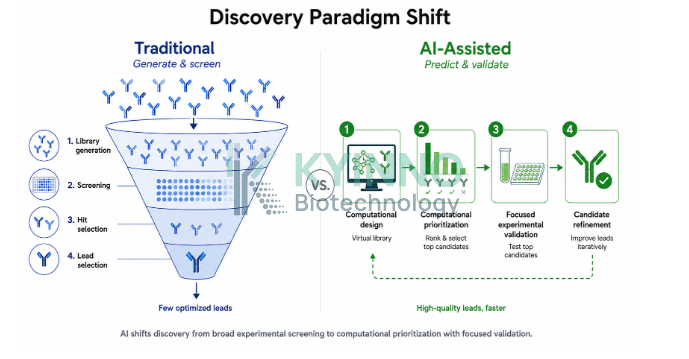
Figure 1. Discovery Paradigm Shift. Diagram comparing the traditional “generate and screen” funnel with an AI-assisted “predict and validate” workflow that incorporates computational prioritization before experimental validation.
Traditional Antibody Discovery Workflow
Immunization and Library Generation
Immunize transgenic mice with target antigen or construct synthetic phage or yeast display libraries. Generate diversity through natural immune responses or combinatorial design. Library size and diversity depend on the discovery platform, library construction method, and screening capacity.
These workflows often depend on optimization of heavy-chain pairing, complementarity-determining regions, and other determinants influencing antibody-antigen interactions.
Screening and Selection
Perform multiple rounds of panning with phage display, sorting with yeast display, or hybridoma screening to enrich for antigen binders. Screen candidate clones using ELISA, flow cytometry, surface plasmon resonance, or other relevant assays.
Lead Identification and Ranking
Express and purify selected candidates, measure binding kinetics, and test functional activity in cell-based assays. Rank candidates by affinity, specificity, mechanism of action, and other program requirements.
This stage often focuses on improving antibody affinity while maintaining favorable developability characteristics.
Affinity Maturation
Generate targeted variants and apply iterative cycles of mutation and selection to improve affinity while preserving specificity and other desirable antibody properties.
Developability Assessment
Empirically test stability, aggregation propensity, polyreactivity, expression yield, and other properties relevant to downstream development. Redesign candidates if significant liabilities are detected.
Early computational developability assessment can identify candidates with unusual sequence- or structure-derived characteristics before extensive downstream characterization.¹⁰
Overall Workflow: Traditional discovery generally progresses through sequential stages of generation, screening, optimization, and experimental developability assessment.
AI-Driven Antibody Discovery Workflow
In Silico Library Design
Use protein language-model representations and other computational design methods to support sequence analysis and the creation of focused candidate sets.⁸ Apply sequence-based or structure-based design constraints and explore possibilities beyond those that can be practically constructed and screened as physical libraries.
Advanced workflows increasingly investigate generative models for sequence and structure design and therapeutic candidate generation. Specific platforms and models should be evaluated against directly relevant experimental studies.
Advanced workflows increasingly use generative models for sequence and structure design and therapeutic candidate generation.
Multi-Parameter Prediction
Run candidates through computational models that assess selected properties such as binding-related characteristics, structural hypotheses, and developability-associated features.
Rank and prioritize candidates that best meet the defined design criteria.
Some prediction platforms may also evaluate structural characteristics, molecular surface features, or other candidate properties. The reliability of these outputs depends on the model, training data, molecular format, and validation design.
Focused Experimental Validation
Synthesize and express a focused set of high-confidence predictions rather than relying exclusively on broad experimental screening.
Validate binding, affinity, and functional activity in the wet lab. Feed experimental results into subsequent computational analyses where appropriate.
AI-Guided Optimization
Deep-learning models can be trained on experimentally screened antibody variants to predict antigen specificity and prioritize new variants for experimental testing.⁹ Experimental outcomes may then inform subsequent candidate-selection cycles.
These computational strategies can support antibody engineering and refinement, but experimental confirmation remains necessary before candidate advancement.
Developability Validation
Confirm computational developability assessments experimentally before advancing candidates, but it does not replace development-relevant biophysical testing.
Overall Workflow: AI-assisted discovery integrates computational prioritization with focused experimental validation and iterative model refinement.
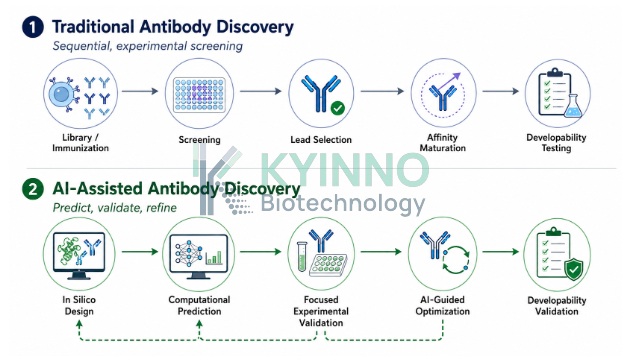
Figure 2. Traditional vs AI-Assisted Antibody Discovery. Diagram showing a predominantly sequential traditional discovery workflow compared with an AI-assisted workflow incorporating computational assessment, experimental validation, and iterative feedback.
Quantifying the Differences: Diversity, Throughput, and Success Rates
| Metric | Traditional Antibody Discovery | AI-Driven Antibody Discovery | Practical Impact |
| Discovery approach | Generate broad experimental libraries, then screen for binders | Predict and prioritize candidates computationally before synthesis | Shifts some work from broad screening to focused validation |
| Sequence diversity | Limited by physical library construction and screening capacity | Can explore much larger virtual sequence spaces | Expands the search beyond what can be tested experimentally |
| Timeline | Often sequential, with separate stages for screening, optimization, and developability testing | Can assess selected properties | May shorten parts of early discovery when models and validation workflows are well integrated |
| Candidates tested experimentally | May require screening many clones or variants | Focuses wet-lab testing on ranked, high-confidence candidates | Can reduce unnecessary synthesis and characterization work |
| Hit identification | Depends on experimental enrichment and clone screening | Uses computational scoring to prioritize candidate pools before validation | Can support prioritization, but still requires wet-lab confirmation |
| Optimization style | Properties may be addressed through separate rounds | Can support multi-parameter candidate assessment | Helps identify potential trade-offs earlier |
| Developability assessment | Often performed after initial binding or functional screening | Can be incorporated earlier through computational profiling | May identify potential liabilities before extensive characterization |
| Best use case | Proven targets, established workflows, and programs where biological selection is preferred | Large sequence-space exploration, constrained experimental capacity, and multi-objective candidate assessment | Hybrid approaches often provide the best balance |
| Key limitation | Experimentally constrained and resource-intensive | Model performance depends on training data quality and validation design | Neither approach should be used without experimental confirmation |
Key Insight: Structure and Interaction Prediction
Deep-learning methods such as AlphaFold and RoseTTAFold have substantially advanced protein-structure prediction, while RoseTTAFold also demonstrated prediction of selected protein interactions.⁶˒⁷ These advances provide structural hypotheses that can support downstream analysis and design.
Predicted protein structures can support structure-informed analysis and hypothesis generation. Predicted complexes may also assist interaction analysis, but antibody-antigen binding modes still require appropriate computational benchmarking and experimental validation.⁶˒⁷
Many next-generation systems also integrate antibody-focused structure-prediction tools. Any named tool should be supported by its own validation study and evaluated according to the antibody format and prediction task.
Concrete Implementation Strategies in Applying AI and Traditional Methods
For computational biologists integrating AI into antibody discovery pipelines, the most effective approach combines AI prediction with targeted experimental validation rather than replacing traditional methods entirely. Here are specific implementation strategies:
Strategy 1: AI-Guided In Vivo Discovery
Leverage natural immune selection for high-quality starting points, then use AI for clone prioritization and optimization:
- Immunize transgenic mice, including humanized mouse models, to generate diverse immune repertoires.
- Deep-sequence immune repertoires after immunization.
- Apply ML models to identify antigen-experienced clones and predict binding likelihood.
- Computationally select diverse, high-confidence binders while considering epitope diversity.
- Express a focused set of top-ranked predicted binders for experimental validation.
- Use computational methods to support subsequent affinity maturation and candidate optimization.
Advantage: Combines biological selection with computational prioritization, allowing experimental resources to focus on candidates with stronger predicted potential.
Strategy 2: Focused Library Design with Generative Models
Replace exclusively random combinatorial approaches with computationally designed, focused libraries:
- Use protein language-model representations and other computational methods to support sequence analysis and focused candidate design.
- Generate candidate sequences according to defined sequence or structural constraints.
- Filter candidates using computational developability assessment methods where appropriate.
- Synthesize a focused library of designed variants for experimental screening.
- Display candidates on yeast or mammalian cells for functional selection.
- Sequence enriched populations and use the resulting data to inform subsequent computational analyses.
Advantage: Focuses experimental screening on computationally prioritized candidates while enabling exploration of sequence possibilities beyond conventional random library design. Suitable for programs where broader computational exploration may complement established experimental discovery methods.
Strategy 3: Lab-in-the-Loop Optimization
Implement iterative design-build-test cycles for antibody optimization:
- Start with a validated lead antibody from traditional or AI-assisted discovery.
- Use computational models to propose mutations predicted to improve target properties.
- Express a focused set of predicted variants during each optimization cycle rather than relying exclusively on large mutagenesis libraries.
- Measure binding kinetics, thermal stability, and aggregation experimentally.
- Use experimental data to inform subsequent computational analyses and candidate-selection decisions.
- Repeat design-build-test cycles as appropriate until candidates meet predefined performance criteria.
Advantage: Supports iterative antibody optimization while allowing experimental results to guide subsequent computational design and candidate-selection cycles.
Hypothetical Example: Designing Antibodies, Not Just Discovering Them
Consider developing a therapeutic antibody against a conserved viral epitope requiring both strong binding affinity and broad strain coverage. Initial experimental screening identifies binders with moderate affinity and limited cross-reactivity.
An AI-assisted approach could use structural models to investigate conserved epitope features, generate or prioritize candidate sequences based on structural and sequence constraints, assess selected candidate characteristics computationally, and prioritize a focused set for experimental validation.
Results from binding and cross-reactivity assays could then be used to inform subsequent computational analyses and optimization decisions.
This type of iterative strategy can help researchers prioritize promising candidates while maintaining experimental validation as a central component of the antibody discovery process.
Such workflows may be relevant to infectious disease research programs where candidate identification, characterization, and optimization require integration of computational and experimental methods.
Specific AI Tools and Frameworks
Several categories of computational tools are being investigated and applied in antibody discovery workflows:
- Generative Models: Computational methods designed to generate or prioritize protein sequences and structures according to learned relationships and defined constraints.
- Protein Language Models: Models such as ESM-2 provide learned protein-sequence representations for downstream computational analysis.⁸
- Structure Prediction: AlphaFold and RoseTTAFold have substantially advanced protein-structure prediction, while RoseTTAFold also demonstrated modeling of selected protein interactions.⁶˒⁷
- Affinity and Property Prediction: Computational methods can support assessment of selected binding-related characteristics and candidate prioritization, depending on the model, training data, and validation strategy.
- Developability Assessment: The Therapeutic Antibody Profiler compares selected sequence- and structure-derived characteristics with distributions observed among clinical-stage antibodies.¹⁰
Commercial and proprietary platforms may integrate combinations of generative modeling, structure prediction, property assessment, and experimental validation. The capabilities and performance of individual platforms should be evaluated according to their supporting evidence and intended application.
How AI and Wet-Lab Validation Work Together
AI does not eliminate the need for experimental validation. It changes what and when you validate. Effective integration requires:
High-quality training data
Models require relevant, well-annotated experimental datasets appropriate to the intended prediction task. Depending on the application, these datasets may include sequences, structures, binding data, and developability profiles. Invest in data infrastructure early.
Rapid express-test workflows
Efficient synthesis and characterization workflows enable iterative design cycles and incorporation of experimental feedback. These capabilities allow computational predictions to be evaluated under relevant experimental conditions.
Continuous model updating
Use experimental results to evaluate model performance and inform subsequent computational analyses where appropriate. Relevant proprietary datasets may support target- or platform-specific model development.
Hybrid decision-making
Use AI to prioritize and guide candidate design, but validate critical properties experimentally before advancing candidates. Balance computational confidence with experimental risk tolerance.
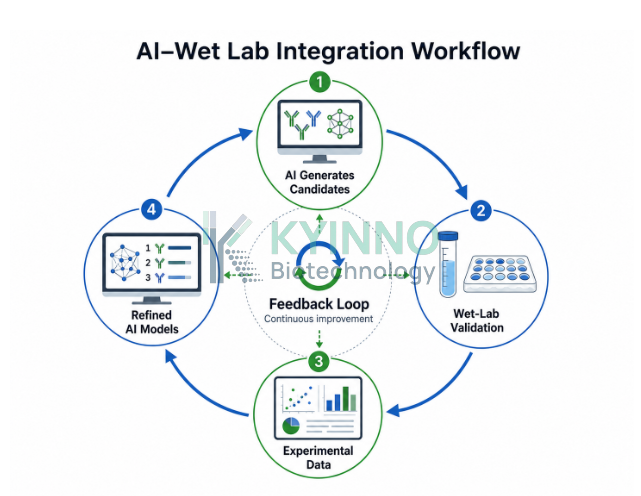
Figure 3. AI-Wet Lab Integration Workflow. Circular diagram showing the iterative cycle: AI generates candidates → wet lab validates selected candidates → experimental data informs AI models → subsequent predictions are refined. Emphasis on feedback loops and continuous improvement.
Common Mistakes and Pitfalls in AI Antibody Discovery
Pitfall 1: Over-Reliance on AI Predictions Without Validation
The Mistake
Trusting AI-generated candidates without experimental confirmation and assuming high prediction scores guarantee success.
The Reality
The performance of AI models for antibody prediction varies by task, dataset, target, and validation strategy. Models developed using a specific antibody system or sequence distribution should not be assumed to generalize reliably to unrelated targets or candidates without independent validation. Predictions are computational estimates, not guarantees.
The Solution
Always validate top AI-predicted candidates experimentally. Use predictions to prioritize and reduce unnecessary experimental work, not to skip validation entirely. Start with focused candidate batches to evaluate model performance on the specific target before scaling the workflow.
Pitfall 2: Insufficient Training Data Quality
The Mistake
Training ML models on sparse, noisy, or poorly annotated datasets, leading to unreliable predictions.
The Reality
Model performance depends critically on training data quality and diversity. Models trained only on published data may not reflect program-specific experimental conditions or development criteria. Inconsistent experimental protocols or measurement errors in training data can propagate to predictions.
Poorly formatted sequence records, inconsistent labeling, and malformed data can substantially reduce model reliability and downstream prediction quality.
The Solution
Invest in systematic data generation with standardized protocols. Prioritize data quality over quantity. Include negative examples, such as non-binders and aggregation-prone sequences, where appropriate.
Continuously expand datasets with internal experimental results to support model development.
Pitfall 3: Ignoring Developability in Early-Stage AI Design
The Mistake
Optimizing only for binding affinity in AI-generated designs while neglecting stability, aggregation propensity, and manufacturability until later stages.
The Reality
High-affinity candidates can still display sequence- or structure-derived characteristics associated with potential developability concerns. Computational profiling can help identify some of these characteristics earlier.¹⁰
The Solution
Apply multi-objective assessment where appropriate. Use computational developability methods to identify candidate characteristics that may warrant additional experimental investigation before extensive downstream characterization.
Design and prioritize candidates according to relevant binding and developability criteria, while experimentally confirming properties required for candidate advancement.
Pitfall 4: Neglecting Experimental Feedback Loops
The Mistake
Running AI predictions as a one-time batch process without incorporating experimental results into subsequent computational analyses.
The Reality
Model performance can depend heavily on the relevance of available training data to the specific target and assay. Experimental validation data can provide valuable information for refining subsequent candidate selection and optimization.
The Solution
Implement integrated computational and experimental workflows where results inform subsequent analyses and candidate-selection decisions. Track prediction performance over time and update workflows where appropriate.
Pitfall 5: Underestimating Traditional Method Value
The Mistake
Viewing AI as a complete replacement for traditional methods and abandoning proven platforms entirely.
The Reality
Traditional in vivo discovery platforms provide biologically selected starting points. Phage and yeast display offer functional selection methods that remain valuable in AI-integrated workflows.
The Solution
Adopt hybrid approaches that combine the strengths of both paradigms. Use traditional antibody discovery methods to generate starting points and computational approaches to support candidate prioritization and optimization.
Let AI expand design exploration while experimental validation confirms functional performance.
Critical Warning: AI Limitations You Must Understand
Variable performance in de novo design
The success of fully de novo antibody design varies substantially across models, targets, training datasets, and experimental validation strategies. Computationally generated candidates therefore require rigorous experimental screening and validation.
Context-dependent accuracy
Models trained predominantly on particular antibody classes or frameworks may perform less reliably when applied to nanobodies, bispecifics, non-human frameworks, or other underrepresented formats.
Dataset bias
Training datasets may overrepresent particular antibody classes, targets, or experimental conditions, potentially affecting model performance on underrepresented discovery problems.
Environmental factors
AI models may not fully account for the complex conditions encountered during experimental assays, formulation, manufacturing, or physiological exposure. Experimental validation under relevant conditions remains essential.
Decision Guidance: When to Use AI vs Traditional Approaches
Choosing between AI-driven, traditional, or hybrid antibody discovery depends on target characteristics, program constraints, and available resources. Use this decision framework to evaluate the optimal approach for your program:
Use Traditional Methods When:
The target is well validated with established precedent
If similar antibodies to related targets have succeeded using traditional platforms, proven workflows may reduce technical uncertainty.
The program accommodates sequential experimental workflows
Standard discovery stages are acceptable, and the organization has mature traditional discovery infrastructure.
Computational resources or AI expertise are limited
Effective AI implementation may require ML engineers, computational biologists, data infrastructure, and computing resources, while traditional methods rely primarily on established laboratory capabilities.
Regulatory strategy prioritizes established development experience
Established discovery and characterization methods may provide useful historical precedent, although regulatory evaluation ultimately focuses on the quality, safety, and efficacy of the resulting therapeutic candidate.
Biological selection is important
In vivo platforms can provide antibody starting points shaped by immune selection.
Use AI-Driven Methods When:
Programs face significant timeline constraints
Computational prioritization may help reduce the number of candidates requiring experimental evaluation.
Traditional methods have struggled with the target
Structure-informed or computationally guided design may provide additional approaches for targets that have been difficult to address using established discovery workflows.
Multi-parameter optimization is required
Computational methods can support assessment of multiple candidate characteristics according to defined prediction objectives.
Large sequence spaces must be explored
Computational methods can evaluate sequence possibilities beyond the practical capacity of physical libraries.
Developability is a known risk
Prospective computational assessment may help identify potential sequence- or structure-derived concerns earlier in the discovery workflow.¹⁰
Proprietary data can support model development
Organizations with relevant internal datasets may develop models tailored to their targets, assays, and discovery workflows.
AI-guided discovery may be applied across therapeutic research areas when relevant data, computational methods, and experimental validation strategies are available.
Use Hybrid Approaches When:
You want to balance computational prioritization with biological validation: Hybrid workflows combine computational methods with experimental discovery and validation.
You are building long-term AI capabilities: Hybrid approaches can generate experimental data that may support future computational model development.
Target difficulty is uncertain: Programs can begin with experimental discovery and apply computational methods during prioritization and optimization.
Resource constraints exist in either area: Hybrid approaches can be adapted to available wet-lab and computational capacity.
| Scenario | Recommended Approach | Rationale |
| Established oncology target with existing phage display infrastructure | Traditional phage display | Proven platform and existing infrastructure |
| Novel viral target requiring broad strain coverage | AI-assisted computational design with focused validation | Computational exploration may support multi-strain candidate design |
| Difficult GPCR target after unsuccessful phage display screening | AI-assisted structure-informed design | Structure-informed methods may provide additional hypotheses for targeting of specific conformational epitopes |
| Standard therapeutic target while building AI capabilities | Hybrid in vivo discovery and AI optimization | Combines biological validation with computational capability development |
| Bispecific antibody requiring precise epitope targeting and developability assessment | Hybrid traditional discovery and AI-guided optimization | Multi-parameter constraints can benefit from computational assessment |
| Exploratory biology program focused on understanding immune responses | Traditional in vivo discovery and single B-cell sequencing | Biological characterization of the immune response is the primary objective |
Decision Framework Summary
The most effective approach depends on your specific constraints and goals rather than a universal “best method.”
Evaluate each program based on:
- Timeline urgency
- Target difficulty and historical precedent
- Available resources and expertise
- Multi-parameter optimization requirements
- Long-term capability-building goals
Hybrid workflows can combine biological validation with computational methods to support both current discovery programs and longer-term technology development.
These strategies may be applied across different biologics programs when computational prioritization and experimental validation address clearly defined discovery needs.
Frequently Asked Questions
What are the main differences between AI-driven and traditional antibody discovery methods?
Traditional methods use biological systems, including hybridomas, phage display, and transgenic mice, to generate and screen antibodies experimentally. AI-driven methods use computational models to predict and prioritize selected antibody characteristics before synthesis, allowing researchers to focus experimental resources on selected candidates.
The fundamental distinction is between broad experimental screening and computationally assisted candidate design and prioritization.
How does AI improve the efficiency and accuracy of antibody drug discovery compared to traditional techniques?
AI can support discovery efficiency by expanding computational exploration of antibody sequence space, supporting multi-parameter assessment, identifying potential developability concerns earlier, and prioritizing candidates for experimental validation.
Structure prediction, property prediction, and integrated computational-experimental workflows can further support candidate design. However, performance depends on data quality, model selection, prediction objectives, and experimental validation.
These capabilities may be valuable in programs developing biologics against challenging targets or optimizing candidates with multiple development requirements.
What challenges in traditional antibody drug discovery does AI aim to address?
AI aims to address several limitations of traditional antibody discovery, including constraints on physical library size, sequential optimization workflows, late identification of potential developability concerns, and resource-intensive experimental screening.
Computational methods can support broader design exploration, assessment of multiple candidate characteristics, and earlier candidate prioritization.
Why is AI becoming a preferred approach in antibody discovery over conventional methods?
Interest in AI-assisted antibody discovery is being driven by advances in protein language models and structure prediction, increasing availability of biological datasets, improvements in computing infrastructure, and demand for more efficient therapeutic discovery workflows.
However, AI is not replacing conventional methods. Hybrid workflows combine experimental discovery and validation with computational prioritization and optimization.
Organizations may use AI as a capability for both near-term discovery support and longer-term technology development.
Can AI completely replace wet-lab validation in antibody discovery?
No. Current AI models provide computational predictions that require experimental confirmation.
The performance of de novo antibody design varies by model, target, dataset, and validation strategy. Effective implementation uses AI to prioritize candidates and guide design while relying on wet-lab validation to confirm binding, functional activity, and developability properties.
Integrated computational and experimental workflows can use validation results to inform subsequent candidate selection and analysis.
What infrastructure is required to implement AI-driven antibody discovery?
Implementation may require:
- Computational infrastructure, including local or cloud-based computing resources for model training and inference.
- ML and computational biology expertise relevant to protein modeling and antibody discovery.
- High-quality datasets, including sequences, binding measurements, structural data, and developability profiles.
- Efficient express-test workflows for experimental validation.
- Data-management systems to track predictions, experimental results, and iterative analyses.
Organizations can build internal capabilities or partner with service providers offering AI-integrated discovery services.
Programs working with immune-repertoire sequencing also require appropriate sample processing, antigen annotation, sequence metadata, and data-management practices.
How accurate are AI predictions for antibody-antigen binding and affinity?
Accuracy varies by prediction task, model, dataset, and target.
Structure-prediction methods have substantially improved protein modeling, while selected computational methods can support candidate ranking and prioritization.⁶˒⁷
Performance may improve when models incorporate relevant, high-quality experimental data. Predictions should therefore be treated as decision-support tools rather than replacements for experimental validation.
Implementing AI in Your Antibody Discovery Program
Organizations at different stages of AI adoption should consider these next steps:
For Early-Stage Exploration
- Pilot hybrid workflows on one discovery campaign to benchmark performance against traditional methods.
- Invest in systematic data collection and annotation infrastructure to enable future model training.
- Partner with service providers offering AI-integrated discovery capabilities to access expertise without building full internal infrastructure.
- Attend focused training on protein language models and structural prediction tools relevant to antibody engineering.
For Scaling Implementation
- Establish dedicated computational biology teams with ML engineering and bioinformatics expertise.
- Build relevant proprietary datasets by systematically characterizing historical and current antibody candidates.
- Implement integrated computational and experimental workflows combining candidate prioritization with efficient express-test capabilities.
- Evaluate target- or program-specific model development where sufficient relevant data are available.
For Advanced Optimization:
- Investigate custom computational or generative models where sufficient proprietary data and validation infrastructure are available.
- Integrate multi-omics data, including transcriptomics and proteomics, with computational models where scientifically relevant.
- Develop integrated design-build-test workflows supported by appropriate synthesis and characterization capabilities.
- Contribute to open-source tools and pre-competitive consortia to advance field-wide capabilities.
Future development efforts will likely require expanded collaboration between computational biology teams, translational scientists, and experts in evolving regulatory frameworks.
Key Resources for Computational Biologists
Model Repositories and Tools:
ImmuneBuilder: Open-source antibody structure prediction-pipeline.
Observed Antibody Space (OAS): A database of cleaned and annotated paired and unpaired antibody sequences for repertoire analysis and computational research.⁵
SAbDab: Curated structural antibody database providing experimentally determined antibody structure data.
ANARCI: Antibody numbering and CDR annotation tool.
Academic Research and Reviews:
- “A new era of antibody discovery: an in-depth review of AI-driven approaches”
- “Therapeutic antibody engineering by high efficiency cell screening”
- “Machine learning for therapeutic antibody design”
Partnering with Kyinno for AI-Integrated Discovery
Kyinno Biotechnology provides antibody discovery services combining computational tools with in vivo platforms and experimental validation workflows.
ATX-Gx Humanized Mouse Platform
Generate immune repertoires through biological selection, with computational methods supporting candidate analysis and prioritization where appropriate.
Proprietary AI/ML Suite
Computational capabilities may support antibody data visualization, candidate selection, clonotype analysis, variant design, and customizable approaches for candidate assessment.
mAbForge Rapid Validation
Express-test workflows supporting experimental evaluation and iterative optimization of antibody candidates.
Integrated Multi-Parameter Optimization
Assessment and optimization of affinity, specificity, cross-reactivity, stability, and pH-dependent binding through integrated computational and experimental workflows.
These capabilities may support biologics discovery programs requiring combinations of antibody generation, computational analysis, experimental validation, and candidate optimization.
The hybrid approach combines biological selection through in vivo discovery with computationally guided candidate prioritization and experimental validation.
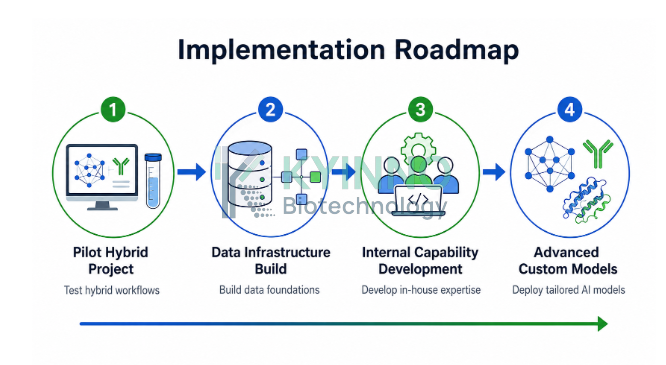
Figure 4. Implementation Roadmap. Flowchart showing progression from pilot hybrid project → data infrastructure build → internal capability development → advanced custom models.
Accelerate Your Antibody Discovery with Kyinno
Discuss your project with our scientific team and explore how AI-integrated discovery platforms can support candidate prioritization, experimental validation, and therapeutic antibody optimization.
Schedule a Consultation
References
- Lu, R. M., Hwang, Y. C., Liu, I. J., Lee, C. C., Tsai, H. Z., Li, H. J., & Wu, H. C. (2020). Development of therapeutic antibodies for the treatment of diseases. Journal of Biomedical Science, 27(1), 1.
https://doi.org/10.1186/s12929-019-0592-z - McCafferty, J., Griffiths, A. D., Winter, G., & Chiswell, D. J. (1990). Phage antibodies: Filamentous phage displaying antibody variable domains. Nature, 348(6301), 552–554.
https://doi.org/10.1038/348552a0 - Boder, E. T., & Wittrup, K. D. (1997). Yeast surface display for screening combinatorial polypeptide libraries. Nature Biotechnology, 15(6), 553–557.
https://doi.org/10.1038/nbt0697-553 - Tiller, T., Busse, C. E., & Wardemann, H. (2009). Cloning and expression of murine Ig genes from single B cells. Journal of Immunological Methods, 350(1–2), 183–193.
https://pubmed.ncbi.nlm.nih.gov/19716372/ - Olsen, T. H., Boyles, F., Deane, C. M., & Martin, A. C. R. (2022). Observed Antibody Space: A diverse database of cleaned, annotated, and translated unpaired and paired antibody sequences. Protein Science, 31(1), 141–146.
https://doi.org/10.1002/pro.4205 - Jumper, J., Evans, R., Pritzel, A., et al. (2021). Highly accurate protein structure prediction with AlphaFold. Nature, 596(7873), 583–589.
https://doi.org/10.1038/s41586-021-03819-2 - Baek, M., DiMaio, F., Anishchenko, I., et al. (2021). Accurate prediction of protein structures and interactions using a three-track neural network. Science, 373(6557), 871–876.
https://doi.org/10.1126/science.abj8754 - Lin, Z., Akin, H., Rao, R., et al. (2023). Evolutionary-scale prediction of atomic-level protein structure with a language model. Science, 379(6637), 1123–1130.
https://doi.org/10.1126/science.ade2574 - Mason, D. M., Friedensohn, S., Weber, C. R., et al. (2021). Optimization of therapeutic antibodies by predicting antigen specificity from antibody sequence via deep learning. Nature Biomedical Engineering, 5(6), 600–612.
https://doi.org/10.1038/s41551-021-00699-9 - Raybould, M. I. J., Marks, C., Krawczyk, K., et al. (2019). Five computational developability guidelines for therapeutic antibody profiling. Proceedings of the National Academy of Sciences, 116(10), 4025–4030.
https://doi.org/10.1073/pnas.1810576116