KC-1499

MC38-CD19-Cell-Line

×
22259
Home » MC38-CD19-Cell-Line

Background of MC38-CD19-Cell-Line

CD19 is a type I transmembrane glycoprotein that functions as coreceptor for the B cell antigen receptor complex (BCR) on B cell lymphocytes, and plays a vital role in humoral immune response. CD19 is expressed throughout B cell development from pre-B-cell differentiation with expression persisting until terminal differentiation into plasma cells, and is commonly used as B cell lineage marker; CD19 is also found on most B cell malignancies including chronic lymphocytic leukemias (CLLs), B cell non- Hodgkin’s lymphomas (NHLs), and more aggressive B-ALL, which lead to the rapid development of therapeutic antibodies and chimeric antigen receptor therapy.

Specifications

Catalog NumberKC-1499
Cell Line NameMC38-CD19-Cell-Line
Host Cell LineMouse MC38 cell line
DescriptionMC38 cell line stable expressing exogenous human CD19 gene
QuantityOne vial of frozen cells (≥2-106/vial)
StabilityStable in culture over a minimum of 10 passages
ApplicationDrug screening and biological assays
Freezing Medium70% DMEM+20% FBS+10% DMSO
Propagation MediumDMEM+10%FBS+5µg/mL Puromycin
Selection MarkerPuromycin
MorphologyEpithelial
SubcultureSplit saturated culture 1:2-1:5 every 3 days; seed out at about 1-3 × 10⁵ cells/mL
Incubation37 °C with 5% CO2
StorageLiquid nitrogen immediately upon receiving
Doubling TimeApproximately 30 hours
Mycoplasma StatusNegative
In Vivo ValidationYes

Cell Line Generation

MC38 human CD19 cell line was generated using a lentiviral vector expressing human CD19 sequence.

Characterization

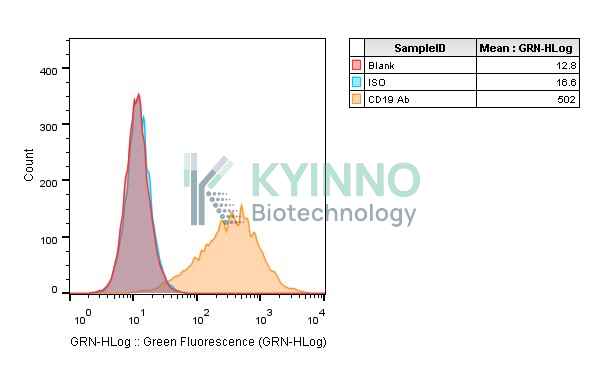
Figure: Characterization of CD19 overexpressing in mouse MC38 stable clones using FACS.

Cell Resuscitation

  1. Prewarm culture medium (DMEM + 10% FBS + 5µg/mL Puromycin)in a 37°C water bath.
  2. Thaw the frozen vial in a 37°C water bath for 1-2 minutes.
  3. Transfer the vial into biosafety cabinet, and wipe the surface with 70% ethanol.
  4. Unscrew the top of the vial and transfer the cell suspension gently into a sterile centrifuge tube containing 9.0mL complete culture medium.
  5. Spin at ~ 125 × g for 5-7 minutes at room temperature, and discard the supernatant without disturbing the pellet.
  6. Resuspend cell pellet with the appropriate volume of complete medium and transfer the cell suspension into a T25 culture flask.
  7. Incubate the flask at 37°C, 5% CO2 incubator.
  8. Split saturated culture 1:2-1:5 every 3 days; seed out at about 1-3 × 10⁵ cells/mL.

Cell Freezing

  1. Prepare the freezing medium (70% DMEM + 20% FBS + 10% DMSO) fresh immediately before use.
  2. Keep the freezing medium on ice and label cryovials.
  3. Transfer cells to a sterile, conical centrifuge tube, and count the cells.
  4. Centrifuge the cells at 250×g for 5 minutes at room temperature and carefully aspirate off the medium.
  5. Resuspend the cells at a density of at least 3×10⁶ cells/mL in chilled freezing medium.
  6. Aliquot 1 mL of the cell suspension into each cryovial.
  7. Freeze cells in the CoolCell freezing container overnight in a -80°C freezer.
  8. Transfer vials to liquid nitrogen for long-term storage

References

  1. Zhou, L., Ord, D., Omori, S. & Tedder, T. Structure of the genes encoding the CD19 antigen of human and mouse B lymphocytes. Immunogenetics 35, 102ÿ111 (1992).
  2. Brentjens, R. J. et al. CD19-targeted T cells rapidly induce molecular remissions in adults with chemotherapyrefractory acute lymphoblastic leukemia. Sci. Transl. Med. 5, (2013).

Use License Agreement

Research Use Only.
Not for use in diagnostic procedures or therapeutic applications.
Redistribution of the cell line or its derivatives is prohibited without prior written permission from Kyinno Biotechnology.