
KC-6179

TMD8-BTK-C481S-T474I-KI Cell Line

×
65911
Home » TMD8-BTK-C481S-T474I-KI Cell Line

Background of TMD8-BTK-C481S-T474I-KI Cell Line

BTK (Bruton tyrosine kinase), also known as AGMX1, is a human protein-coding gene. The protein encoded by this gene plays a crucial role in B-cell development. Mutations in this gene cause X-linked agammaglobulinemia type 1, which is an immunodeficiency characterized by the failure to produce mature B lymphocytes, and associated with a failure of Ig heavy chain rearrangement. Alternative splicing results in multiple transcript variants encoding different isoforms.

Specifications

Catalog NumberKC-6179
Cell Line NameTMD8-BTK-C481S-T474I-KI Cell Line
Clone Number1C2
Host Cell LineTMD8
DescriptionTMD8 cell line with BTK C481S T474I knock-in
QuantityOne vial of frozen cells (≥2×10⁶ cells)
StabilityStable in culture over a minimum of 10 passages
ApplicationDrug screening and biological assays
Freezing Medium70% RPMI 1640+20% FBS+10% DMSO
Propagation MediumRPMI1640+10%FBS
Selection MarkerNA
MorphologyLymphoblast-like
SubcultureSplit at a ratio of 1:4–1:6 every 2–3 days
Incubation37°C with 5% CO₂
StorageLiquid nitrogen immediately upon receiving
Doubling TimeEstimated 19–36 hours
Mycoplasma StatusNegative
In Vivo ValidationNA

Cell Line Generation

The TMD8-BTK-C481S-T474I-KI cell line was generated using CRISPR/Cas9-mediated knock-in to introduce the BTK-C481S-T474I-KI variant.

Characterization

Figure 1: Characterization of TMD8-BTK-C481S-T474I-KI cell line stable clone using PCR sequencing.

Figure 2: Characterization of TMD8-BTK-C481S-T474I-KI cell line stable clone using RT-PCR sequencing.
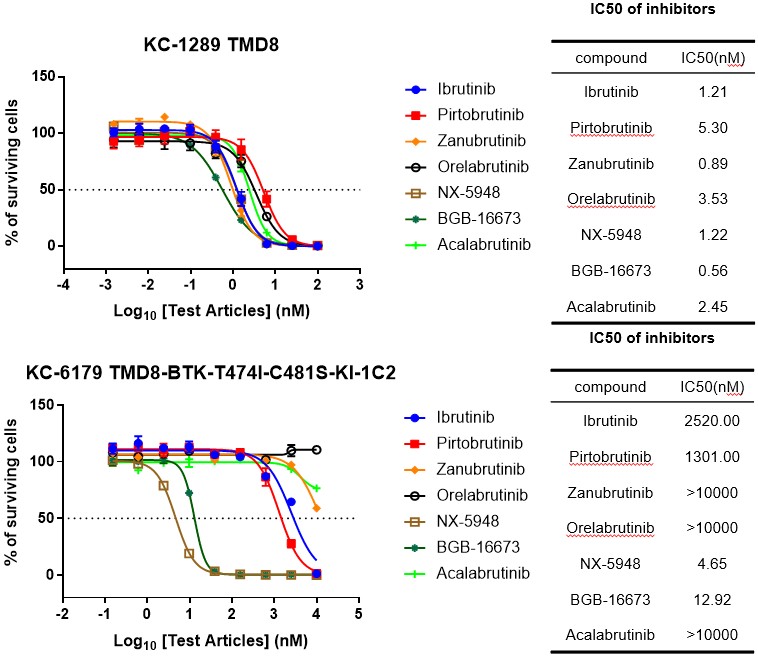
Figure 3: Characterization of Dose-response curves and IC50 values for TMD8 and TMD8-BTK-C481S-T474I-KI cells treated with Ibrutinib,Pirtobrutinib,Zanubrutinib,Orelabrutinib,NX-5948,BGB-16673 and Acalabrutinib over 5 days.

Cell Resuscitation

  1. Pre-warm complete culture medium (basal medium and 10% FBS) in a 37°C water bath.
  2. Rapidly thaw the cryovial in a 37°C water bath for 1-2 minutes with gentle agitation.
  3. Transfer the vial to a biosafety cabinet, and disinfect the exterior with 70% ethanol.
  4. Aseptically transfer the cell suspension dropwise into a sterile centrifuge tube containing 9.0 mL of pre-warmed complete medium.
  5. Centrifuge at approximately 125 × g for 5–7 minutes at room temperature, carefully aspirate the supernatant without disturbing the cell pellet.
  6. Gently resuspend the pellet in an appropriate volume of complete medium and transfer the suspension into a T25 flask.
  7. Incubate the flask in a 37°C in a humidified 5% CO₂ incubator.
  8. Assess cell viability and morphology after 24 hours. If cells appear healthy, replace the medium with fresh medium supplemented with the appropriate selective antibiotic.
  9. Subculture the cells at a ratio of 1:4–1:6 every 2–3 days upon reaching 80%–90% confluency.

Cell Freezing

  1. Prepare the freezing medium (70% basal medium, 20% FBS and 10% DMSO) freshly before use.
  2. Pre-chill the freezing medium on ice and label the cryovials accordingly.
  3. Transfer the cell suspension to a sterile conical tube and perform a cell count to determine total viability and density.
  4. Centrifuge the cells at 250×g for 5 minutes at room temperature; carefully aspirate the supernatant.
  5. Gently resuspend the pellet in chilled freezing medium, ensuring a minimum cell density of 3×10⁶ cells/mL.
  6. Aliquot 1 mL of the cell suspension into each pre-labeled cryovial.
  7. Place the cryovials into a CoolCell® container and store at -80°C overnight for controlled-rate cooling.
  8. Transfer the cryovials to the liquid nitrogen for long-term storage the following day.

References

  1. Mohamed AJ, Yu L, Bäckesjö CM, et al. Bruton's tyrosine kinase (Btk): function, regulation, and transformation with special emphasis on the PH domain. Immunol Rev. 2009;228(1):58.
  2. Liu W, Quinto I, Chen X, et al. Direct inhibition of Bruton's tyrosine kinase by IBtk, a Btk-binding protein. Nat Immunol. 2001;2(10):939.
  3. Tsubata T, Wienands J. B cell signaling. Introduction. Int Rev Immunol. 2001;20(6):675.

Use License Agreement

Research Use Only.
Not for use in diagnostic procedures or therapeutic applications.
Redistribution of the cell line or its derivatives is prohibited without prior written permission from Kyinno Biotechnology.