KC-4191

293T-GRE-Luc2 Cell Line

×
42620
Home » 293T-GRE-Luc2 Cell Line

Background of 293T-GRE-Luc2 Cell Line

Glucocorticoid receptor (GR) signaling is a key endocrine pathway regulating metabolism, immune response, and stress response. The glucocorticoid response element (GRE) is a specific DNA sequence that mediates transcriptional activation upon ligand binding to the glucocorticoid receptor. GRE-driven reporter cell lines enable quantitative measurement of GR pathway activation in response to glucocorticoids and their antagonists, supporting drug discovery for inflammatory diseases, autoimmune disorders, and metabolic conditions.

Specifications

Catalog NumberKC-4191
Cell Line Name293T-GRE-Luc2 Cell Line
Clone Number7-9#
Host Cell Line293T
DescriptionHEK293T reporter cell line stably expressing glucocorticoid response element (GRE)-driven luciferase reporter for glucocorticoid receptor agonist and antagonist screening
QuantityOne vial of frozen cells (≥2×10⁶ cells)
StabilityStable in culture over a minimum of 10 passages
ApplicationDrug screening and biological assays
Freezing Medium70% DMEM+20% FBS+10% DMSO
Propagation MediumDMEM+10%FBS+150μg/mL Hygromycin B
Selection MarkerHygromycin B
MorphologyEpithelial-like
SubcultureSplit at a ratio of 1:5–1:8 every 2–3 days
Incubation37°C with 5% CO₂
StorageLiquid nitrogen immediately upon receiving
Doubling TimeEstimated 16–31 hours
Mycoplasma StatusNegative
In Vivo ValidationYES

Cell Line Generation

The 293T-GRE-Luc2 cell line was generated using a lentiviral vector expressing the GRE-driven Luc2 reporter sequence.

Characterization

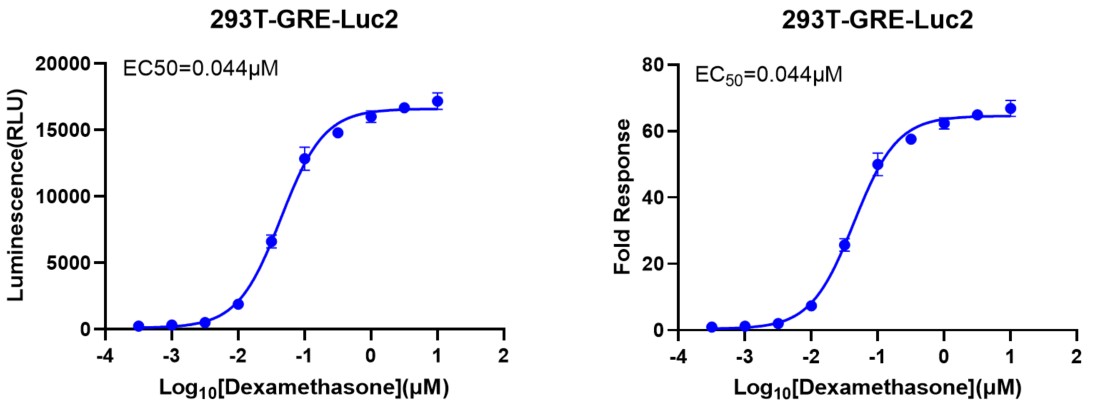
Figure 1: 293T-GRE-Luc2 cells were seeded into the 96-well plate, and treated with the highest concentration 10μM Dexamethasone, 3.16 times diluted to 10 concentrations. After reaction for 16 hours, readout with Bright-lite Luciferase Assay system.

Cell Resuscitation

  1. Pre-warm complete culture medium (basal medium and 10% FBS) in a 37°C water bath.
  2. Rapidly thaw the cryovial in a 37°C water bath for 1-2 minutes with gentle agitation.
  3. Transfer the vial to a biosafety cabinet, and disinfect the exterior with 70% ethanol.
  4. Aseptically transfer the cell suspension dropwise into a sterile centrifuge tube containing 9.0 mL of pre-warmed complete medium.
  5. Centrifuge at approximately 125 × g for 5–7 minutes at room temperature, carefully aspirate the supernatant without disturbing the cell pellet.
  6. Gently resuspend the pellet in an appropriate volume of complete medium and transfer the suspension into a T25 flask.
  7. Incubate the flask in a 37°C in a humidified 5% CO₂ incubator.
  8. Assess cell viability and morphology after 24 hours. If cells appear healthy, replace the medium with fresh medium supplemented with the appropriate selective antibiotic.
  9. Subculture the cells at a ratio of 1:5–1:8 every 2–3 days upon reaching 80%–90% confluency.

Cell Freezing

  1. Prepare the freezing medium (70% basal medium, 20% FBS and 10% DMSO) freshly before use.
  2. Pre-chill the freezing medium on ice and label the cryovials accordingly.
  3. Transfer the cell suspension to a sterile conical tube and perform a cell count to determine total viability and density.
  4. Centrifuge the cells at 250×g for 5 minutes at room temperature; carefully aspirate the supernatant.
  5. Gently resuspend the pellet in chilled freezing medium, ensuring a minimum cell density of 3×10⁶ cells/mL.
  6. Aliquot 1 mL of the cell suspension into each pre-labeled cryovial.
  7. Place the cryovials into a CoolCell® container and store at -80°C overnight for controlled-rate cooling.
  8. Transfer the cryovials to the liquid nitrogen for long-term storage the following day.

References

  1. Rhen T, Cidlowski JA. New insights into glucocorticoid receptor action: new mechanisms, new therapeutics. N Engl J Med. 2023;388(13):1217-1228.
  2. Oakley RH, Cidlowski JA. Cellular mechanisms of glucocorticoid action and resistance. J Clin Invest. 2021;131(19):e152136.
  3. Busillo JM, Cidlowski JA. The five molecular actions of glucocorticoids. Mol Cell Endocrinol. 2021;535:111382.

Use License Agreement

Research Use Only.
Not for use in diagnostic procedures or therapeutic applications.
Redistribution of the cell line or its derivatives is prohibited without prior written permission from Kyinno Biotechnology.