KC-3760

293T-AQP4-M23 Cell Line

×
34728
Home » 293T-AQP4-M23 Cell Line

Background of 293T-AQP4-M23 Cell Line

AQP4 encodes aquaporin 4 and is also known as MIWC. This protein is the predominant aquaporin found in brain and has an important role in brain water homeostasis. Alternatively spliced transcript variants encoding different isoforms have been described for this gene. Additional isoforms, resulting from the use of alternative in-frame translation initiation codons, have also been described. Recent studies provided evidence for translational readthrough in this gene, and expression of C-terminally extended isoforms via the use of an alternative in-frame translation termination codon.

Specifications

Catalog NumberKC-3760
Cell Line Name293T-AQP4-M23 Cell Line
Host Cell Line293T
Description293T-AQP4-M23 is a stable engineered cell line expressing human AQP4-M23
QuantityOne vial of frozen cells (≥2×10⁶ cells/vial)
StabilityStable in culture over a minimum of 10 passages
ApplicationDrug screening and biological assays
Freezing Medium70% DMEM + 20% FBS + 10% DMSO
Propagation MediumDMEM + 10% FBS + 1μg/mL Puromycin
Selection MarkerPuromycin
MorphologyEpithelial
SubcultureSplit at a ratio of 1:4–1:6 every 2–3 days
Incubation37 °C with 5% CO₂
StorageLiquid nitrogen immediately upon receiving
Doubling TimeEstimated 19–36 hours
Mycoplasma StatusNegative
In Vivo ValidationNA

Cell Line Generation

293T-AQP4-M23 cell line was generated using a lentiviral vector expressing the human AQP4-M23 sequence.

Characterization

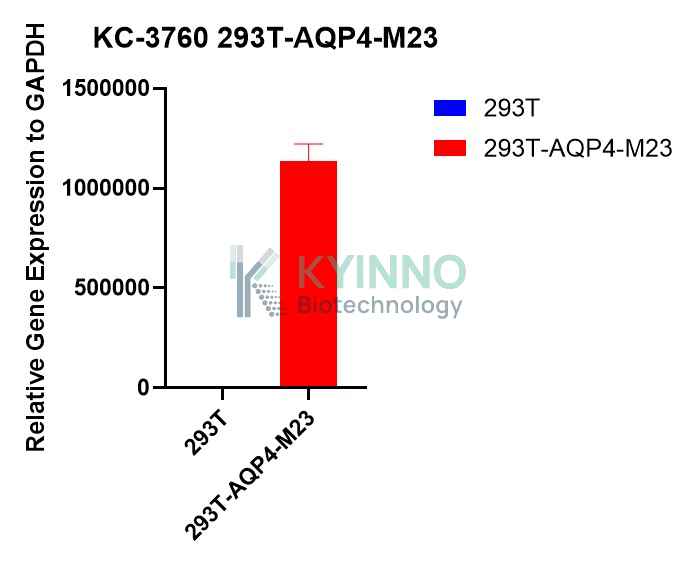
Figure: Characterization of AQP4-M23 overexpression in 293T stable clone using QPCR.

Cell Resuscitation

  1. Pre-warm complete culture medium (basal medium and 10% FBS) in a 37°C water bath.
  2. Rapidly thaw the cryovial in a 37°C water bath for 1-2 minutes with gentle agitation.
  3. Transfer the vial to a biosafety cabinet, and disinfect the exterior with 70% ethanol.
  4. Aseptically transfer the cell suspension dropwise into a sterile centrifuge tube containing 9.0 mL of pre-warmed complete medium.
  5. Centrifuge at approximately 125 × g for 5–7 minutes at room temperature, carefully aspirate the supernatant without disturbing the cell pellet.
  6. Gently resuspend the pellet in an appropriate volume of complete medium and transfer the suspension into a T25 flask.
  7. Incubate the flask in a 37°C in a humidified 5% CO₂ incubator.
  8. Assess cell viability and morphology after 24 hours. If cells appear healthy, replace the medium with fresh medium supplemented with the appropriate selective antibiotic.
  9. Subculture the cells at a ratio of 1:4–1:6 every 2–3 days upon reaching 80%–90% confluency.

Cell Freezing

  1. Prepare the freezing medium (70% basal medium, 20% FBS and 10% DMSO) freshly before use.
  2. Pre-chill the freezing medium on ice and label the cryovials accordingly.
  3. Transfer the cell suspension to a sterile conical tube and perform a cell count to determine total viability and density.
  4. Centrifuge the cells at 250×g for 5 minutes at room temperature; carefully aspirate the supernatant.
  5. Gently resuspend the pellet in chilled freezing medium, ensuring a minimum cell density of 3×10⁶ cells/mL.
  6. Aliquot 1 mL of the cell suspension into each pre-labeled cryovial.
  7. Place the cryovials into a CoolCell® container and store at -80°C overnight for controlled-rate cooling.
  8. Transfer the cryovials to the liquid nitrogen for long-term storage the following day.

References

  1. Luo W, Peng N, Wei S et al. Why repair fails in AQP4-IgG-positive neuromyelitis optica spectrum disease: an astrocyte-centered framework for remyelination and neuroaxonal preservation. Frontiers in immunology. 2026;17:1889927. PMID: 42872052. doi: 10.3389/fimmu.2026.1889927.
  2. Rotstein DL, Beauchemin P, Burton JM et al. Optimizing the management of AQP4 antibody-positive NMOSD: A Canadian consensus. Multiple sclerosis and related disorders. 2026 Sep 21;115:107936. PMID: 42815166. doi: 10.1016/j.msard.2026.107936.
  3. Liu W, Wu J, Liu Z et al. A systematic review and meta-analysis of the efficacy and safety of eculizumab in AQP4-IgG-positive neuromyelitis optica spectrum disorder. Multiple sclerosis and related disorders. 2026 Aug 22;115:107678. PMID: 42697106. doi: 10.1016/j.msard.2026.107678.

Use License Agreement

Research Use Only.
Not for use in diagnostic procedures or therapeutic applications.
Redistribution of the cell line or its derivatives is prohibited without prior written permission from Kyinno Biotechnology.